
At-a-Glance Guide & Overview:
This comprehensive guide defines the business-critical role of website audits in the modern digital economy, specifically optimised for search visibility, user experience (UX), and technical performance metrics in 2026.
Core Definition
What is a Website Audit? A website audit is an in-depth, data-driven assessment of a website’s overall performance, functionality, compliance, and user experience. It serves as a diagnostic health checkup to align digital assets with commercial business goals and uncover hidden technical blockages.
The 4 Core Components
Technical SEO Audit: Evaluates backend architecture, XML sitemaps, robots.txt, canonical structures, and crawlability parameters to optimise indexation.
User Experience (UX) Audit: Reviews user navigation pathways, form fields, layout friction, and checkout flows to maximise conversion potential.
Performance & Speed Audit: Assesses page load times, script execution, image sizes, and infrastructure stability.
Content Quality Audit: Analyses on-page metadata, keyword targeting accuracy, internal link equity, and copy relevance.
Key Goals & Strategic Business Impact
Improved Search Rankings: Removes systemic algorithmic roadblocks to lift search engine result visibility.
Higher Conversion Rates (ROI): Mitigates user friction and fixes broken user pathways to elevate commercial conversion rates.
Optimised Page Speeds: Targets code bloating and inefficient hosting to lower bounce rates; resolving speed deficits is vital given that 53% of mobile visitors abandon pages taking over 3 seconds to load.
Actionable Analytics Roadmaps: Shifts operational maintenance from speculative guesswork to prioritised, high-impact technical execution.
The Standard Audit Workflow
[Phase 1: Crawling & Discovery] ➔ [Phase 2: Analytics & GSC Data Integration] ➔ [Phase 3: UX/UI Analysis] ➔ [Phase 4: Prioritised Site Audit Report]Critical Performance Benchmarks
Core Web Vitals (CWV): Strict maintenance of Largest Contentful Paint (LCP ≤ 2.5s), Interaction to Next Paint (INP ≤ 200ms), and Cumulative Layout Shift (CLS ≤ 0.1).
Metadata & On-Page Assets: Structural verification of title lengths, meta descriptions, and accessible image alt text.
Architecture Integrity: Eradication of 404 errors, dead internal links, and duplicate page paths to preserve crawler efficiency.
In the modern digital economy, your website serves as the virtual shopfront, the primary lead generation engine, and the central hub for your brand’s online presence. However, simply launching a website and leaving it untouched is no longer sufficient to remain competitive. Just as a physical property or a complex piece of machinery requires regular maintenance and structural reviews, a corporate website demands routine evaluation. This comprehensive evaluation is known as a site audit.
Many businesses fail to realise that behind a visually appealing homepage lies a sophisticated network of code, server configurations, content structures, and user pathways. When these elements begin to degrade or fall out of alignment with modern standards, your visibility on search engines suffers, and your user experience declines. Understanding what is a website audit and learning how to implement its findings is one of the most critical steps a business can take to secure its digital footprint, boost organic traffic, and ultimately increase revenue.
What is a Website Audit?
At its fundamental level, a website audit is a comprehensive, data-driven assessment of a website’s overall performance, functionality, and user experience. It functions as a thorough checkup, analysing how well a site aligns with its business objectives and identifying technical, structural, or strategic weaknesses that hinder performance and search engine visibility. To conduct a website audit means to look objectively at where your platform excels and where it falls short, moving past surface-level metrics like basic traffic counts.
The primary objective of a comprehensive site audit is to identify underlying vulnerabilities that prevent your platform from ranking higher on search engine results pages (SERPs). By uncovering hidden technical glitches, broken user pathways, and outdated optimisation practices, a business gains a clear, actionable roadmap for improvement. Whether you operate a boutique e-commerce store or a multinational enterprise portal, regular audits ensure your digital asset remains functional, secure, and fully aligned with your broader commercial objectives.
💡 Did You Know?
Businesses that proactively perform regular website audits experience up to a 61% boost in organic search traffic. Furthermore, fixing structural UX flaws via an audit helps organisations achieve an average 32% higher conversion rate simply by removing digital friction.
Official Source:
- SEO Audits Statistical Breakdown – Industry study published by SEOmator.
Have questions? Call our friendly team at 1300 158 708
The Core Components of a Website Audit
A truly comprehensive review cannot look at a website through a single lens. Digital ecosystems are multi-faceted, requiring different types of website audits to address distinct pillars of digital performance. A balanced evaluation relies on four core components:
1. Technical SEO Audits
Technical seo audits focus entirely on the backend architecture of your website. This process ensures that search engine crawlers can seamlessly discover, read, and index your website without encountering systemic blockages. Technicians look closely at your XML sitemaps, robots.txt files, canonical tags, and URL structures to guarantee that search engines can interpret your site layout efficiently.
2. Performance and Speed Audits
User patience is at an all-time low. Performance audits isolate factors affecting page speeds and overall site performance. This involves examining server response times, image compression, script execution, and mobile responsiveness to guarantee a friction-free experience across all device types.
3. Content Quality and On-Page Audits
An on-page assessment evaluates the actual material hosted on your domains. Analysts look at content quality, keyword alignment, internal linking structures, and metadata to ensure your copy satisfies both human readers and search algorithms. It helps identify thin content, duplicate pages, or outdated information that might be diluting your brand authority.
4. User Experience (UX) Audits
A UX audit focuses specifically on how easily and pleasantly visitors can navigate your site and locate information. This structural analysis reviews user flows, form functionalities, checkout accessibility, and layout issues that might cause a potential customer to leave before converting.
Why Your Business Needs a Site Audit?
Many organisations operate under the misconception that if their website is online, it is functioning perfectly. In reality, silent seo issues accumulate over time, steadily eroding your market share. When you run a website audit, you unlock four key business benefits:
1. Improved Search Rankings
The algorithms governing search engine optimisation are in a constant state of evolution. An audit identifies and fixes the underlying technical hurdles and structural flaws that actively block your search visibility, ensuring your site complies with contemporary ranking signals.
2. Higher Conversion Rates
An audit isolates where users encounter friction or broken pathways, such as broken links (404 errors) or faulty form fields. By upgrading your user experience and smoothing out these pathways, you naturally increase your ROI and conversion metrics.
3. Improved Performance and Page Speeds
A delay of even a few seconds in page load time can dramatically increase bounce rates, causing prospective clients to abandon your site. Pinpointing technical blockages allows you to streamline code, improve core web vitals, and radically accelerate delivery times.
4. Actionable Insights
Rather than guessing what needs attention, an audit delivers a prioritised roadmap to address site weaknesses. This gives your development and content teams the exact steps needed to protect your market positioning and grow your traffic.
💡 Did You Know?
Performance is tied directly to customer retention. Aggregated web performance research monitored by Colorlib reveals that a staggering 53% of mobile visitors will completely abandon a webpage if it takes longer than 3 seconds to load. Crucially, as mobile load times stretch from 1 to 5 seconds, the probability of a user bouncing away skyrockets by 90%.
- 50+ Site Speed Statistics: Page Load, CWV & Performance (2026) – Colorlib
- Page Speed and Decreased Conversion Rates – 2023 Statistics – OuterBox
Have questions? Call our friendly team at 1300 158 708
The Step-by-Step Website Audit Process
To get the maximum value out of your investigation, the audit process must be handled systematically. A haphazard review yields disjointed data, whereas a structured methodology produces highly actionable insights.
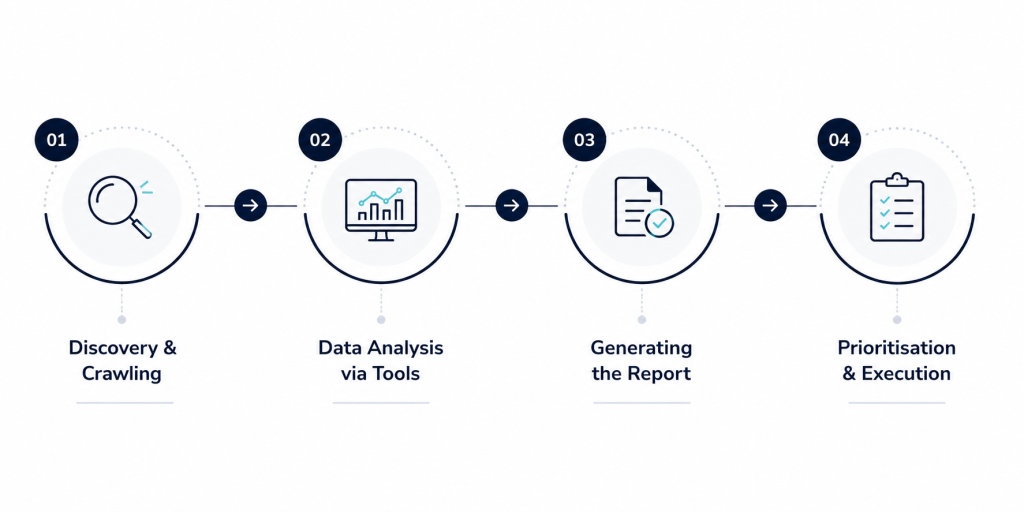
Phase 1: Data Gathering and Crawling
The process initiates by deploying specialised crawling software that mimics the behavior of search engine spiders. This software navigates through every folder, sub-domain, and individual URL on your site, cataloguing architectural details, status codes, and structural assets.
Phase 2: Interrogating Core Analytics Platforms
To understand real-world user behavior and indexing status, you must deeply integrate data from platforms like google search console and Google Analytics. This step exposes how search engines currently view your indexing health, alerts you to manual penalties, highlights keyword impressions, and uncovers any mobility or usability errors reported straight from the source.
Phase 3: Analysing User Experience Metrics
Next, the audit transitions into evaluating user experience (UX) and user interface (UI) factors. Analysts look at navigation clarity, form functionalities, checkout flows, and accessibility compliance, making sure that once traffic arrives, it can convert effortlessly.
Phase 4: Compiling and Prioritising the Action Plan
The culmination of these stages is the production of a formalised site audit report. Rather than dumping an overwhelming list of flaws onto a stakeholder’s desk, professional audit reports categorise findings by severity (e.g., Critical Errors, Warnings, and Notices). This allows your development and content teams to systematically tackle high-impact fixes first, guaranteeing an immediate return on your optimisation investment.
Critical Metrics Highlighted in a Site Audit Report
When reviewing your finalised site audit report, you will encounter a variety of technical parameters that require careful attention. Understanding these metrics is vital for managing your ongoing digital strategy.
| Metric / Element | Practical Focus Areas | Strategic Business Impact |
| Core Web Vitals | Largest Contentful Paint (LCP), Interaction to Next Paint (INP), Cumulative Layout Shift (CLS). | Measures real-world loading performance, interactivity, and visual stability during page rendering. |
| Meta Tag & Metadata | Structural integrity of header tags, meta descriptions, and title lengths. | Directly influences click-through rates (CTR) from search engine results pages. |
| On-Page Visual Assets | Implementation of descriptive alt text for all uploaded images. | Boosts accessibility compliance for visually impaired users and aids in Google Image search rankings. |
| Crawlability & Indexing | Robots.txt directives, XML sitemap validation, elimination of duplicate paths. | Ensures search engines allocate crawl budget effectively to your highest-converting pages. |
Conclusion: Turning Insights into Business Growth
A website is not a static brochure; it is a dynamic, living entity that requires consistent monitoring and refinement. Investing time and resources into understanding what is a website audit is only the first half of the equation; the true business value materialises when you execute the solutions detailed within your audit reports.
By systematically resolving technical hurdles, upgrading your content quality, rectifying broken links, and ensuring your core web vitals are immaculate, you create a digital environment that delights users and commands respect from search engine algorithms. Do not wait for your traffic to plummet or your conversion rates to drop before taking action. Commit to a routine website audit schedule, protect your market positioning, and ensure your digital shopfront continuously performs at its absolute peak.
Sharing is caring!
