Home > AI Overview Optimisation
The landscape of search engine marketing is undergoing its most significant transformation since the inception of the internet. With the introduction of the Google AI Overview (formerly known as the search generative experience or SGE), the primary objective of search engine optimisation has evolved. It is no longer enough to simply rank number one on the traditional search engine results pages; your brand must now be synthesised, recognised, and cited in ai overviews to capture modern search traffic.
At Visual Marketing Australia, we provide cutting-edge ai overview optimisation services designed specifically to transition your digital assets from traditional static indexing into fluid, authoritative answers for complex conversational algorithms. Whether a user triggers a traditional search or activates a dedicated ai mode within google’s search, our data-driven frameworks ensure your business remains at the top of the search landscape.


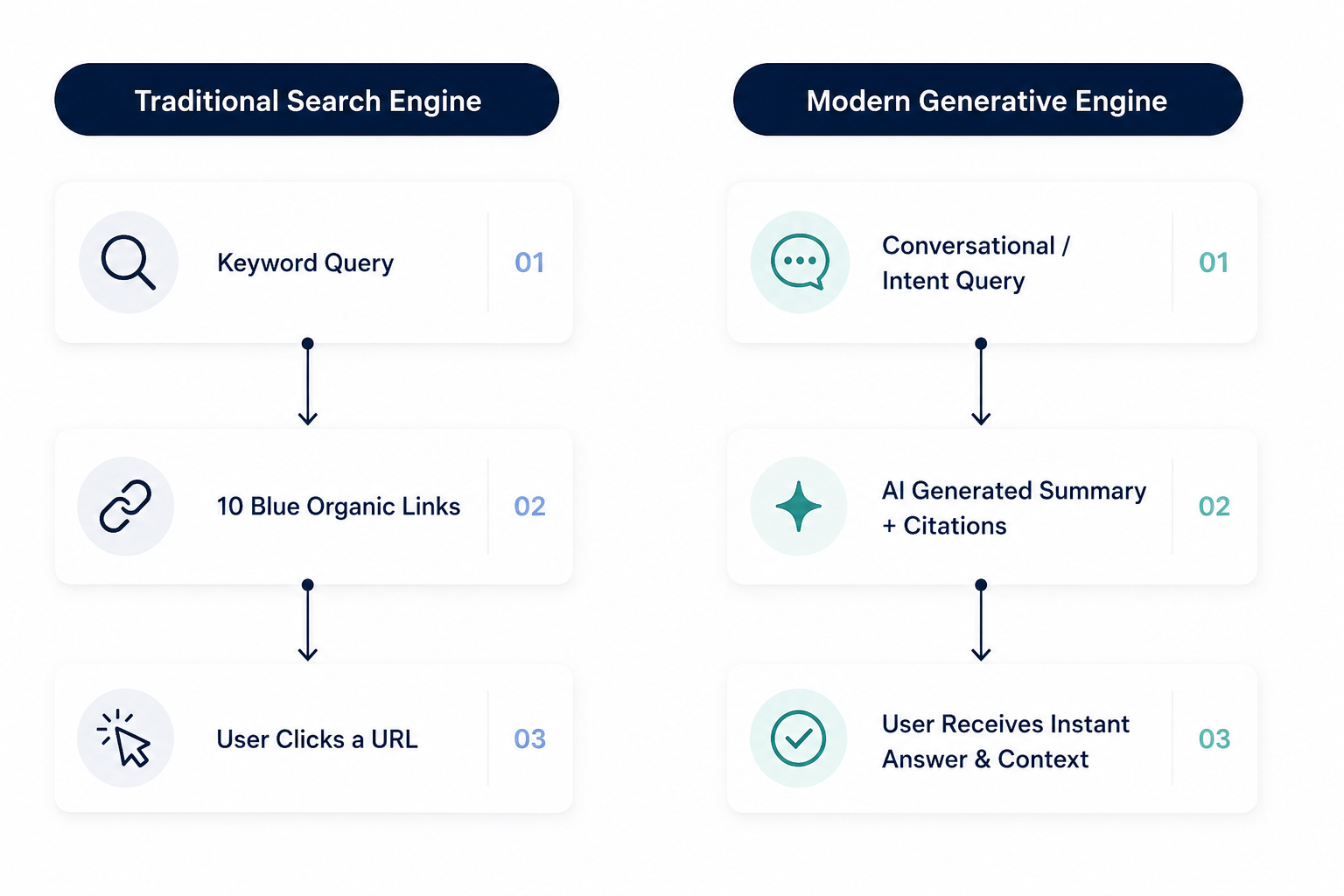
For over two decades, digital marketing relied heavily on optimising content for a list of ten blue organic links. Users typed brief phrases into a search box, and search engines returned a standard search results page populated with matching sites.
Today, Google utilises a sophisticated large language model to construct instant, ai generated summaries at the absolute peak of the user interface. These summaries pull data from multiple web properties simultaneously, answering the search query directly without necessarily requiring the user to click through to a traditional website.
This structural shift alters consumer behavior. To maintain visibility, businesses must adapt their seo strategy to feed these language models structured, authoritative, and easily digestible information. Our specialised services bridge the gap between traditional architectures and the conversational needs of modern machine-learning platforms.
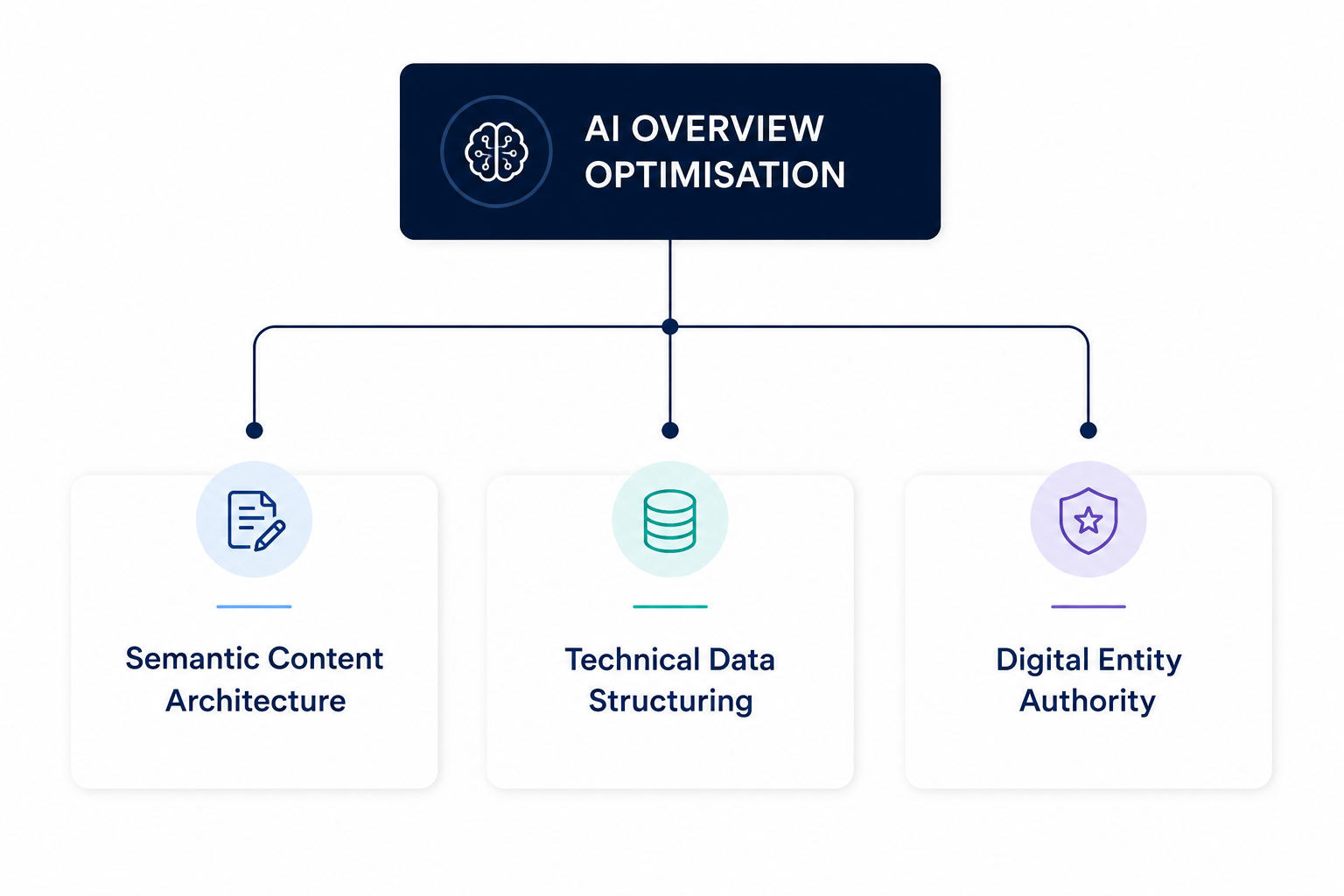
Our specialised agency framework treats generative optimisation as an advanced discipline, combining precise technical engineering with highly contextual semantic content creation.
Large language models do not merely scan for isolated keywords; they analyse the underlying intent and relationship between concepts. We rebuild your informational assets to speak directly to these parsing engines.
Direct Answer Marketing: We structure your core content sections to provide immediate, definitive definitions and explanations. This layout aligns perfectly with how generative models extract summary paragraphs.
Structured Information Hierarchies: We transform dense paragraphs into clear bullet points and numbered lists, as modern search engines heavily favor scannable formatting when generating real-time summaries.
The technical foundation of your website must be perfectly clear to ensure an automated crawler can index your data without ambiguity.
Custom Schema Markup: We implement precise structured data protocols, embedding custom schema scripts directly into your source code. This gives automated engines explicit declarations regarding your services, physical corporate locations, pricing models, and client reviews.
Topical Connectivity: By linking related internal elements through advanced semantic nesting, we make it exceptionally easy for a large language model to understand your core topical authority.
To be selected as a trusted reference within a generative answer, your website must display unmistakable signals of real-world trust and expertise.
Data Density and Accuracy: We enrich your digital footprint with undeniable factual data, regional case studies, and exact metrics that language models can confidently leverage as verifiable reference points.
Algorithmic Trust Optimisation: We align your entire digital ecosystem—including your corporate website, Google Business Profile, and active third-party review platforms—to build a unified entity map that Google recognizes as highly authoritative.

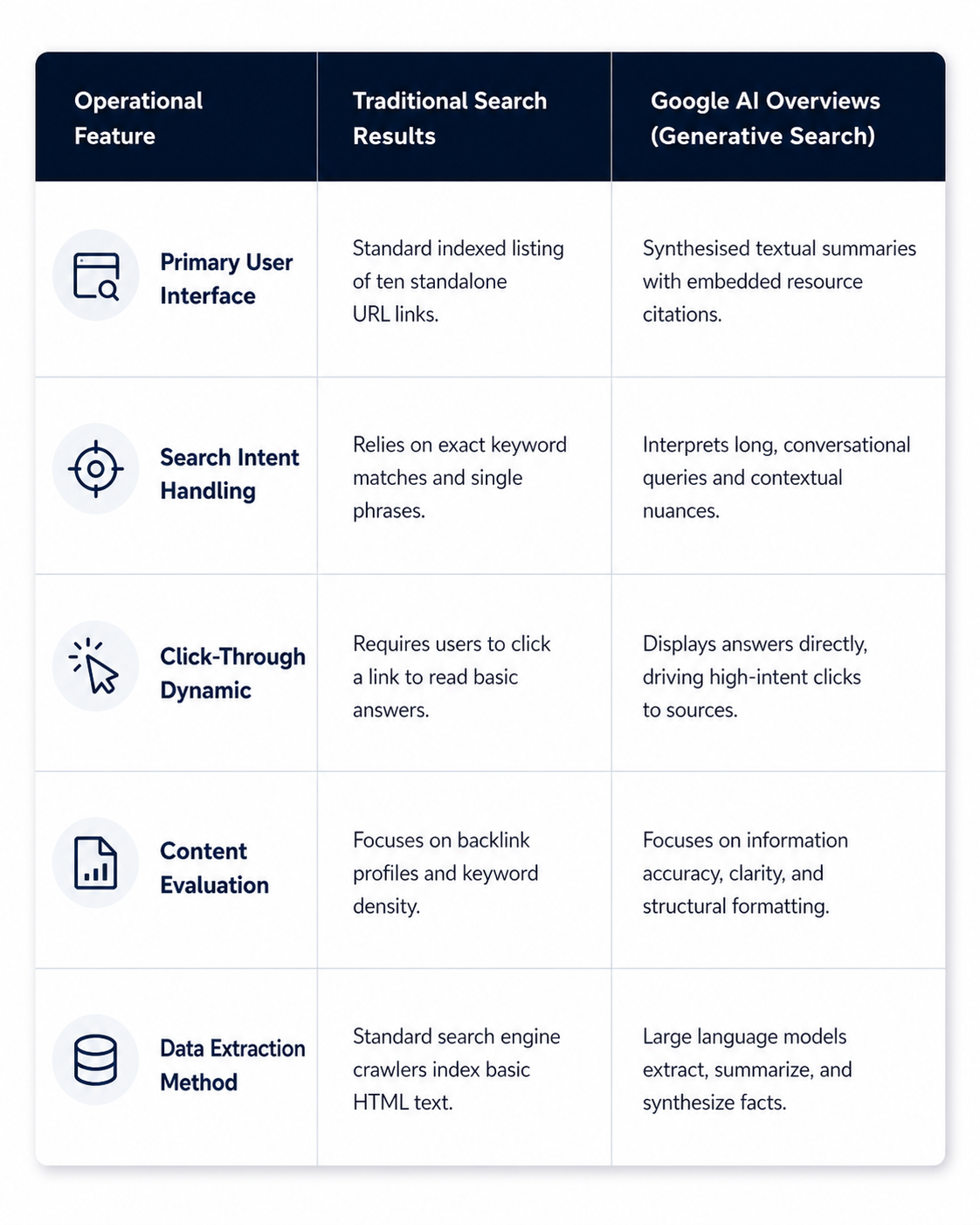
To allocate your marketing budget effectively, it is critical to understand how generative search modules differ from legacy search configurations. While traditional search engines function as digital directories, Google’s AI Overview operates as an automated synthesis platform. This evolution changes how content is evaluated, extracted, and presented to your audience.
Large language models do not merely scan for isolated keywords; they analyse the underlying intent and relationship between concepts. We rebuild your informational assets to speak directly to these parsing engines.
The technical foundation of your website must be perfectly clear to ensure an automated crawler can index your data without ambiguity.
Custom Schema Markup: We implement precise structured data protocols, embedding custom schema scripts directly into your source code. This gives automated engines explicit declarations regarding your services, physical corporate locations, pricing models, and client reviews.
Topical Connectivity: By linking related internal elements through advanced semantic nesting, we make it exceptionally easy for a large language model to understand your core topical authority.
To be selected as a trusted reference within a generative answer, your website must display unmistakable signals of real-world trust and expertise.
While visible text formatting is essential for human readers, backend code remains a vital piece of the optimisation puzzle.

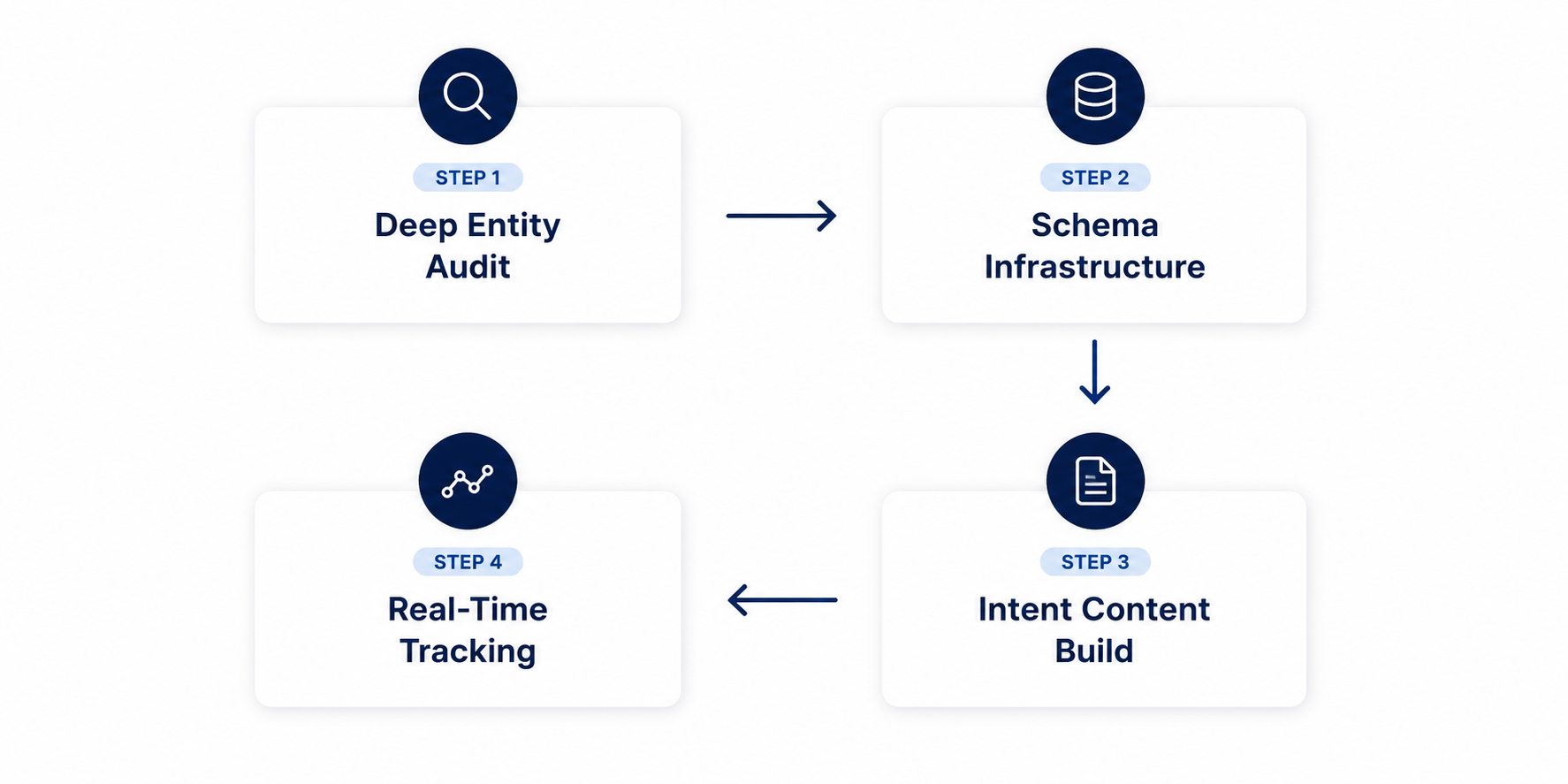
When you partner with Visual Marketing Australia for your generative optimisation campaign, you receive an end-to-end technical and creative overhaul designed to maximise your visibility in modern organic search.
Large language models do not merely scan for isolated keywords; they analyse the underlying intent and relationship between concepts. We rebuild your informational assets to speak directly to these parsing engines.
Direct Answer Marketing: We structure your core content sections to provide immediate, definitive definitions and explanations. This layout aligns perfectly with how generative models extract summary paragraphs.
Structured Information Hierarchies: We transform dense paragraphs into clear bullet points and numbered lists, as modern search engines heavily favor scannable formatting when generating real-time summaries.
The technical foundation of your website must be perfectly clear to ensure an automated crawler can index your data without ambiguity.
Custom Schema Markup: We implement precise structured data protocols, embedding custom schema scripts directly into your source code. This gives automated engines explicit declarations regarding your services, physical corporate locations, pricing models, and client reviews.
Topical Connectivity: By linking related internal elements through advanced semantic nesting, we make it exceptionally easy for a large language model to understand your core topical authority.
To be selected as a trusted reference within a generative answer, your website must display unmistakable signals of real-world trust and expertise.
Data Density and Accuracy: We enrich your digital footprint with undeniable factual data, regional case studies, and exact metrics that language models can confidently leverage as verifiable reference points.
Algorithmic Trust Optimisation: We align your entire digital ecosystem—including your corporate website, Google Business Profile, and active third-party review platforms—to build a unified entity map that Google recognises as highly authoritative.
Generative search interfaces are highly dynamic, with summaries changing frequently based on user behavior and model updates.


The rise of generative summaries does not mark the end of search engine optimisation; rather, it introduces a more sophisticated era of digital marketing. For years, businesses could achieve modest success by generating repetitive, keyword-stuffed articles designed solely to influence basic indexing algorithms. In the age of artificial intelligence, those legacy strategies are no longer effective.
Modern language models are explicitly programmed to filter out low-value fluff and unhelpful text repetitions. They look for crisp, authoritative expressions of unique information, primary research data, and distinct regional expertise.
To remain viable, your brand must transition from producing generic web copy to building an ecosystem of high quality, deeply factual media. Our optimisation processes refine your existing content assets, transforming standard marketing brochures into authoritative reference documents that machine-learning engines can securely rely upon for accurate data extraction.
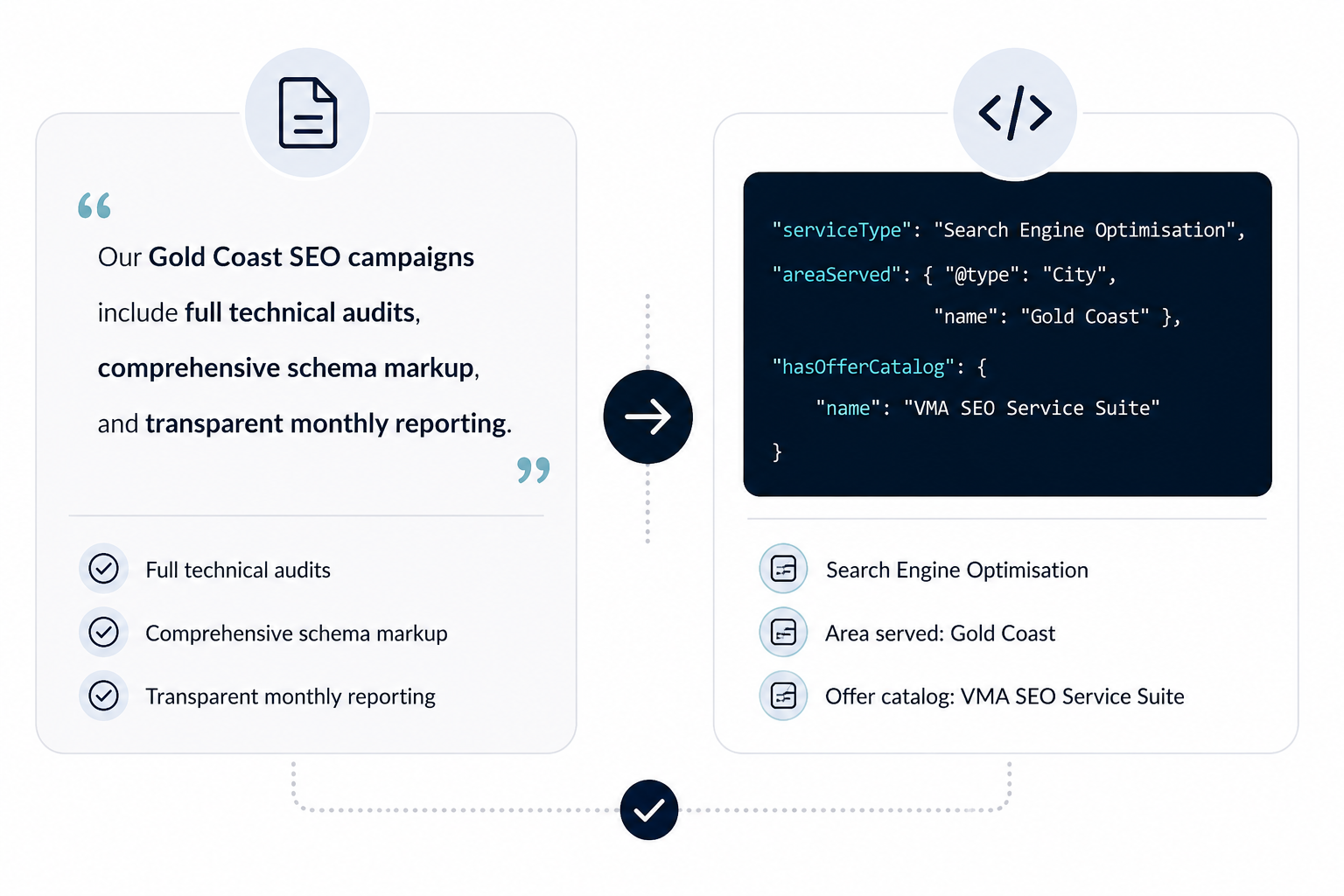
While visible text formatting like headers and list items is essential for human readers and linguistic analysis, backend code remains a vital piece of the optimisation puzzle. Structured data provides search engines with an unambiguous, machine-readable translation of your web pages.
When Google constructs an answer block regarding costs, timelines, or local availability, it cross-references the visible text on a page with the hidden JavaScript Object Notation for Linked Data (JSON-LD) nested within the site’s code.
If your website lacks this advanced layer of technical markup, language models must infer your operational details, leaving your business vulnerable to exclusion in favor of a competitor whose site features immaculate technical code. We manage this entire technical implementation, aligning your hidden code with your visible content to build a flawless data package for search engines.

“Succeeding within generative search summaries relies entirely on engineering high-utility content that AI models can effortlessly parse, validate, and trust. By prioritising unhindered technical accessibility—ensuring your asset files are completely open to automated crawling, prioritising structured text layers over flat media, and using flawless internal link connectivity—you align your domain directly with the primary extraction parameters used by Google’s language algorithms.”
Digital marketing is a discipline defined by continuous evolution. Resting on legacy organic rankings while search interfaces shift toward generative integration introduces significant business risk. As more users embrace conversational search behaviors and explore dedicated ai mode features, the volume of traffic driving directly to standard, unoptimised links will naturally adjust.
Investing in proactive ai overview optimisation establishes your brand as an early leader in the next generation of digital commerce. By restructuring your content assets, validating your local business authority through immaculate code, and fulfilling Google’s criteria for generative citations, you ensure that your business remains prominently featured wherever your customers choose to search.

An AI Overview is an automated summary block generated by Google at the very top of the search results page. It uses an advanced language model to synthesise facts from multiple web sources, providing users with an instantaneous answer to their query alongside clickable citation badges for deeper reading.
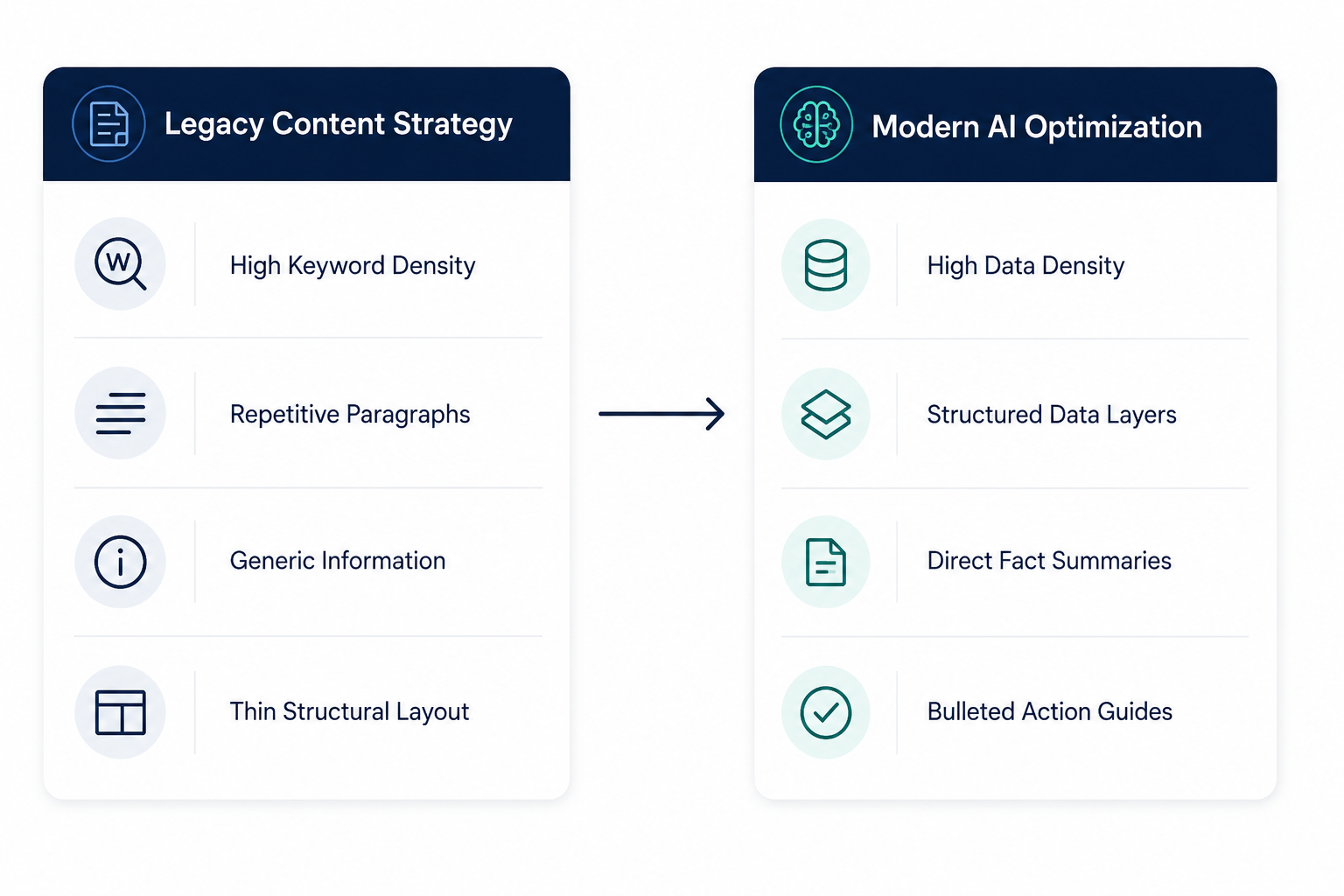
Traditional SEO focuses primarily on keyword frequencies, meta descriptions, and backlink profiles to rank a URL in the standard organic listings. Optimising for AI overviews requires a strong emphasis on content structure, clear heading hierarchies, direct answer formatting, high data density, and immaculate backend schema markup to ensure the information is easily summary-ready for a language model.
Not at all. In fact, the two strategies complement each other perfectly. The improvements required to succeed in generative search—such as clarifying your heading structures, implementing advanced schema code, and elevating the factual depth of your content—are the exact quality signals that improve your traditional organic results as well.
Because generative search databases refresh dynamically as language models crawl the web, changes can sometimes be observed relatively quickly once Google re-indexes the page. Generally, we recommend allowing several weeks after deploying text adjustments and structured data scripts for the search engine to process the updates and update its summary variations.
Yes. Google’s generative model selects its reference sources based on the clarity, accuracy, and structural relevance of the information relative to the specific search query. Websites that position their answers clearly and back them with clean schema markup are frequently selected as citations, even if they sit further down on the traditional first page of search results.
Take your online visibility to new heights with a tailored AI Overview optimisation strategy built by Visual Marketing Australia. More traffic, more leads, more growth — it all starts here.