
Users want instantaneous answers whenever they search things up. The emergence of zero-click searches—where users access information directly from search engine results pages (SERPs) without clicking through to a website—has revolutionised how businesses consider SEO and content marketing.
This shift challenges traditional metrics like click-through rates (CTR) and forces marketers to rethink their strategies. Instead of solely chasing clicks, brands must now focus on capturing attention within the SERPs themselves. This article explores the zero-click search phenomenon, its implications for digital marketing, and actionable strategies to thrive in this new environment.
Summary: Zero-Click Search Guide
What is zero-click search?
Zero-click searches occur when Google answers queries directly in SERPs using features like featured snippets, knowledge panels, or local packs—without sending users to a website.Why does zero-click search matter?
It changes user behaviour, reduces organic traffic, and shifts SEO focus toward visibility and brand credibility.How does zero-click search affect SEO?
It forces marketers to adapt strategies—balancing fewer clicks with greater authority and visibility in search results.What strategies help in a zero-click world?
Target question-based queries, optimise for snippets, strengthen local SEO, add schema markup, and create visual/video content.What is the future of zero-click search?
With AI-powered results (SGE), zero-click searches will grow—making E-E-A-T and voice search optimisation critical.What are the key zero-click SERP features?
Featured snippets, knowledge panels, local packs, People Also Ask boxes, and AI-generated answers.How can businesses succeed despite fewer clicks?
Optimise for snippets, local packs, PAA, and branded searches, while focusing on visibility and authority.How do you measure success in a zero-click world?
Use impressions, SERP visibility, branded search growth, and voice search performance instead of only CTR.
Have questions? Call our friendly team at 1300 158 708
What is Zero-Click Searches?
Zero-click searches happen when search engines such as Google deliver instant answers via featured snippets, knowledge panels, local packs, or other SERP features. SparkToro (2019) states in a study that about 50% of all Google searches result in no click to an external website. This has only increased with technological advancements in AI, voice search, and Google’s constantly increasing answer boxes.
For example, if you search for “What’s the weather in Sydney today?” on Google, the search results instantly show the temperature, forecast, and humidity at the top of the page. Since the answer is already displayed, users don’t need to click on any website for more details.
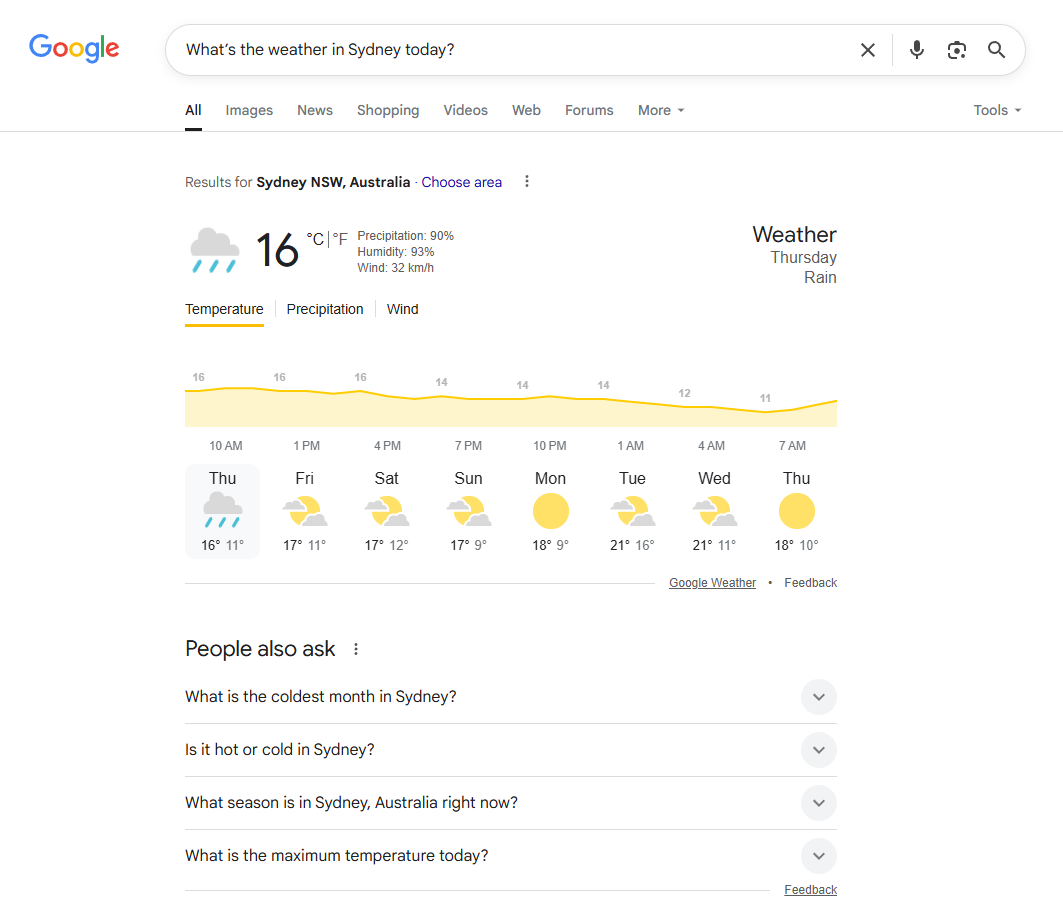
There’s even a 7-day forecast chart and a “People also ask” section with related questions. Since all the key information is visible without leaving Google, most users won’t click through to a weather website.
Why Zero-Click Searches Matter
1. User Behaviour Change – New searchers value speed and convenience. If a query is directly answered on the SERP, they might not need to click through to a website.
2. Decreasing Organic Traffic – Companies banking on conventional SEO might witness dwindling traffic as increasing queries are fulfilled without clicks.
3. Brand Credibility – Although clicks aren’t generated, showing up in featured snippets increases visibility and credibility.
How Zero-Click Search Revolutionises SEO
The advent of zero-click search has compelled SEO experts to change their tactics. Conventional methods designed to drive traffic to a site now vie with Google’s inclination for keeping users within its own environment. It decreases direct clicks but also brings new prospects for brand visibility and authority generation.
For instance, showing in a Featured Snippet makes a company a thought leader in their field, even if users do not click through to their site. But it also signifies that companies have to work twice as hard to turn eyeballs into engagement, as fewer clicks might translate to fewer leads and sales.
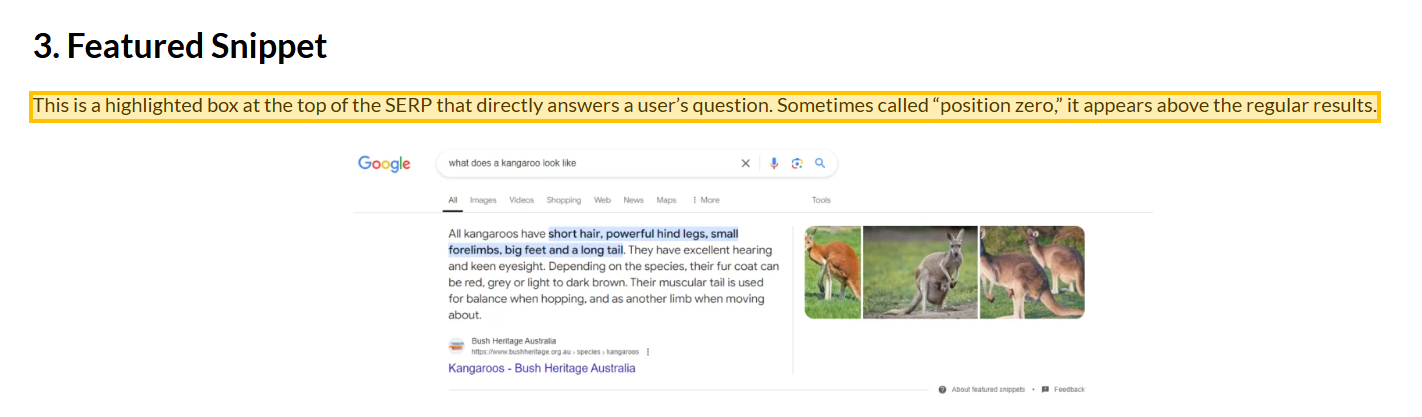
As covered in our earlier article Understanding SERPs, a Featured Snippet is the highlighted box at the top of Google’s results that directly answers a user’s question.
Optimising in a Zero-Click World
In order to thrive in this new environment, companies need to optimise for fast, direct answers instead of mere traditional keyword rankings. This entails:
• Taking aim at question-based search queries (i.e., “How to repair a leaky tap” rather than “plumbing advice”).
• Formatting content for Featured Snippets with brief, well-presented answers.
• Anchoring schema markup to enable Google to extract content into rich results.
• Tightening local SEO to feature in Local Packs and Maps.
• Developing video and visual content that ranks within Google’s image and video carousels.
The Future of SEO in a Zero-Click Era
As Google’s AI-answered results (such as Search Generative Experience, or SGE) become available, zero-click searches are only going to grow. This will require businesses to pay even more attention to brand awareness, E-E-A-T (Experience, Expertise, Authoritativeness, Trustworthiness), and voice search optimisation. While the loss of clicks can feel like an obstacle, it also offers a chance to own SERPs in new ways—by making yourself the source that Google draws on for instant answers.
Key Zero-Click Search Features
Search engines have moved on from simple links to other sites—they now provide immediate answers on the results page. For marketers, it is necessary to understand these features to optimise for visibility even when users do not click through. Here, we discuss the most salient zero-click search features and what they mean.
1. Featured Snippets (Position Zero)
Featured snippets, also referred to as “Position Zero,” rank at the top of the search results on Google in a highlighted box. They give brief answers to the query of users by extracting them from highly ranked web pages. The snippets are available in different formats:
- Paragraph snippets – A short textual answer (usually 40–60 words).
- List snippets – Numbered or bulleted steps (for example, “How to repair a leaky tap”).
- Table snippets – Structured data comparison (for example, “Best smartphones 2024”).
Why They Are Important:
- They occupy prominent SERP real estate, boosting brand awareness.
- Sites included in snippets tend to experience elevated perceived authority, even as clicks decrease.
- Voice assistants such as Google Home regularly read out featured snippets.
Optimisation Tip:
Organise content to respond directly to frequent questions in plain, concise language. Ahrefs or SEMrush can assist in finding snippet opportunities by examining “People Also Ask” questions.
2. Knowledge Panels
Knowledge panels are on the right side of desktop SERPs (or at the top on mobile) for entity searches like brands, celebrities, or landmarks.
Google aggregates this data from reputable sources like:
- Wikipedia
- Official website of companies
- Government databases
- Industry-specific authoritative websites
Why They’re Important:
They boost credibility by showing authenticated information (e.g., year founded, principal executives). Consumers don’t click away as the panel gives instant answers.
Optimisation Tip:
Ensure your Google Knowledge Graph listing is correct by claiming ownership through Google Search Console.
- Have an up-to-date Wikipedia listing (if relevant) and identical branding throughout directories.
3. Local Packs & Maps
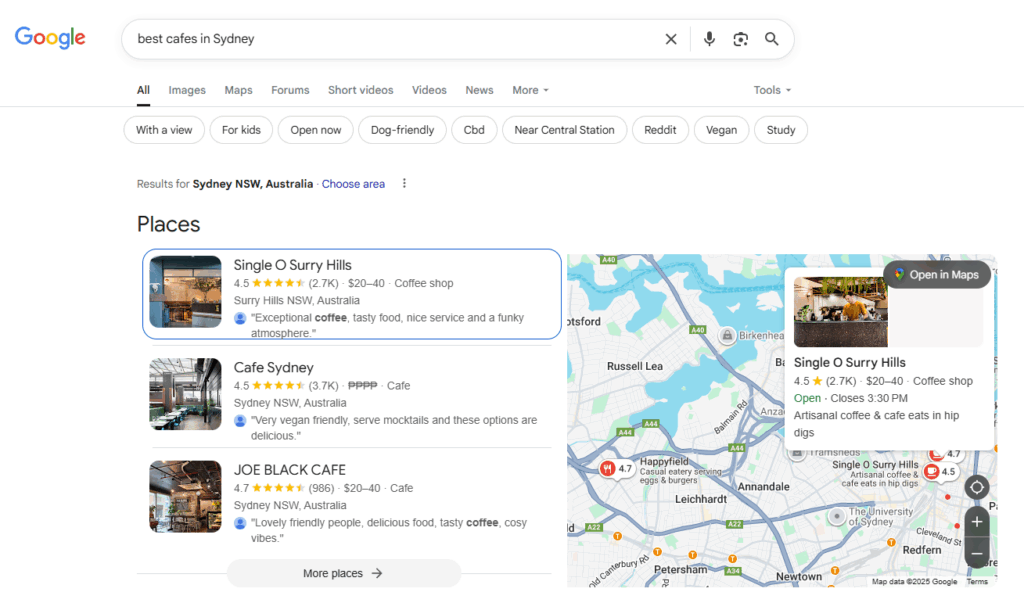
For location-based searches (“near me” or for places like “best café in Sydney”), Google shows a local pack—a map with three business listings—and occasionally a local finder with additional choices.
Why They Matter:
- More than 46% of Google searches involve local intent.
- Users often call or visit a business directly from the SERP without clicking its website.
Optimisation Tip:
- Optimise your Google Business Profile (GBP) with:
- Accurate contact details.
- High-quality photos.
- Keyword-rich business descriptions.
- Encourage customer reviews, as they influence rankings.
4. People Also Ask (PAA) Boxes
PAA boxes are expandable sections that provide follow-up questions related to the original search. Clicking a question reveals a brief answer, often sourced from featured snippets.
Why They Matter:
- They retain users on the SERP and minimise clicks to sites.
- Every expansion is a possible snippet opportunity.
Optimisation Tip:
- Inspect PAA questions with tools such as AnswerThePublic or AlsoAsked.com.
- Publish content providing answers in scannable format (e.g., Q&A subheadings).
You may also like: Understanding SERPs: A Beginner’s Guide to Search Engine Results Pages
5. AI-Generated Answers (SGE – Search Generative Experience)
Google is piloting AI Overviews, which employ generative AI to piece together multi-source responses to complicated questions (e.g., “Best hiking trails for beginners in NSW”).
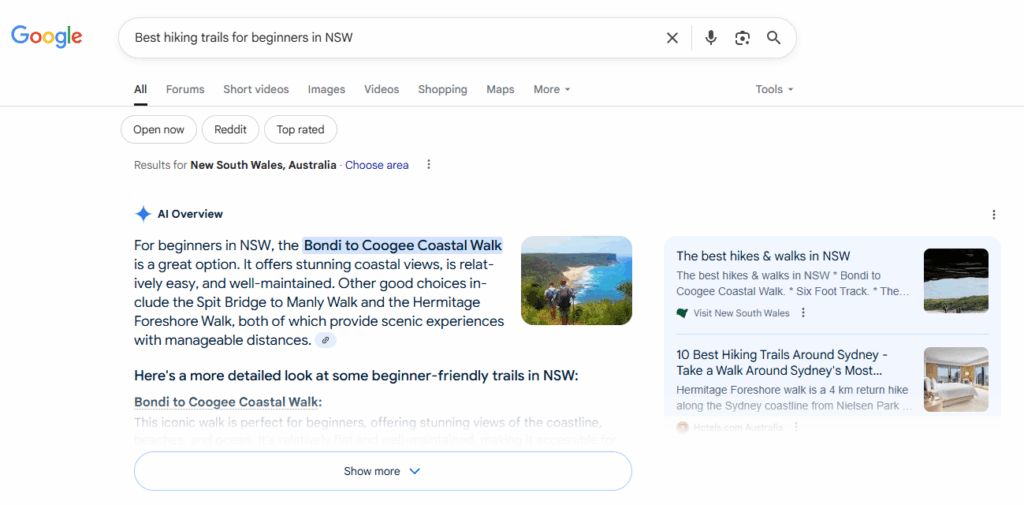
These sit above organic results and can contain:
- Summarised highlights.
- Product comparisons.
- Links to sources (though users may not follow them).
Why They Matter:
- Ahead-of-time tests indicate SGE might affect 65% of queries (BrightEdge, 2023).
- Brands not quoted in AI responses stand to lose exposure altogether.
Optimisation Tip:
- Prioritise E-E-A-T (Experience, Expertise, Authoritativeness, Trustworthiness) in content.
- Use a conversational tone to match the way AI reads questions.
You may also like: AI SEO: How to Get Noticed in Google AI Overviews
How to Adjust Your Strategy for Zero-Click Success
Though zero-click searches diminish website traffic, they open new doors for brand presence and authority. Here’s how companies can adjust.
1. Optimise for Featured Snippets
As featured snippets tend to take from high-ranking pages, optimising for them is essential.
- Answer Questions Briefly – Organise content in concise, easy-to-digest formats (bullet points, tables, brief paragraphs).
- Utilise Schema Markup – Organised data makes it easier for search engines to comprehend and extract information.
- Optimise for Long-Tail Searches – Voice searches and question searches are more likely to trigger snippets.
2. Make Use of Local SEO for Zero-Click Visibility
For physical businesses, showing up in local packs is crucial.
- Optimise Google Business Profile (GBP) – Update accurate NAP (Name, Address, Phone Number), high-quality photos, and up-to-date business hours.
- Encourage Reviews – Positive reviews enhance rankings in local search results.
3. Branded Searches & Knowledge Panels
Though informational searches might result in zero clicks, branded searches are still pivotal.
- Claim & Optimise Knowledge Panel – Ensure correct information for Google by verifying your entity through Google’s Knowledge Graph.
- Have a Robust Wikipedia Profile (if relevant) – Google frequently draws information from Wikipedia.
4. Develop Content for “People Also Ask” (PAA) Boxes
PAA boxes are a treasure trove for visibility.
- Find Common PAA Questions – Utilise tools such as AnswerThePublic or SEMrush to find related questions.
- Offer Clear, Authoritative Responses – Organise content as Q&A format to boost snippet opportunity.
5. Get Ready for AI-Powered Search (SGE)
Google’s AI Summaries will probably reign supreme in upcoming SERPs.
- Prioritise E-E-A-T (Experience, Expertise, Authoritativeness, Trustworthiness) – High-quality, expert-backed content will be favoured.
- Adopt a Conversational Tone – AI-generated answers mimic natural language, so content should align with how people speak.
Measuring Success in a Zero-Click World
Traditional metrics like CTR may no longer suffice. Instead, consider:
- Impressions & SERP Visibility – Track how often your brand appears in snippets or knowledge panels.
- Branded Search Volume – More searches of your brand name show increased awareness.
- Voice Search Performance – Since voice assistants depend so much on zero-click answers, voice query optimisation is critical.
Conclusion: Beyond the Click
The advent of zero-click searches does not signal the demise of SEO—it just realigns it. By optimising for SERP features, companies can stay visible and credible even in the absence of explicit clicks. The secret is in delivering instant value, organising content for rapid consumption, and embracing changing search habits.
As Google goes on improving its AI prowess, the marketers will have to remain nimble, focusing on quality and relevance rather than the old traffic metrics. Capturing attention prior to the click is as valuable in this new age as the click itself.
Further Reading & References
Have questions? Call our friendly team at 1300 158 708
By embracing these strategies, businesses can thrive in an increasingly zero-click world—where visibility and authority matter more than ever.
Sharing is caring!


